
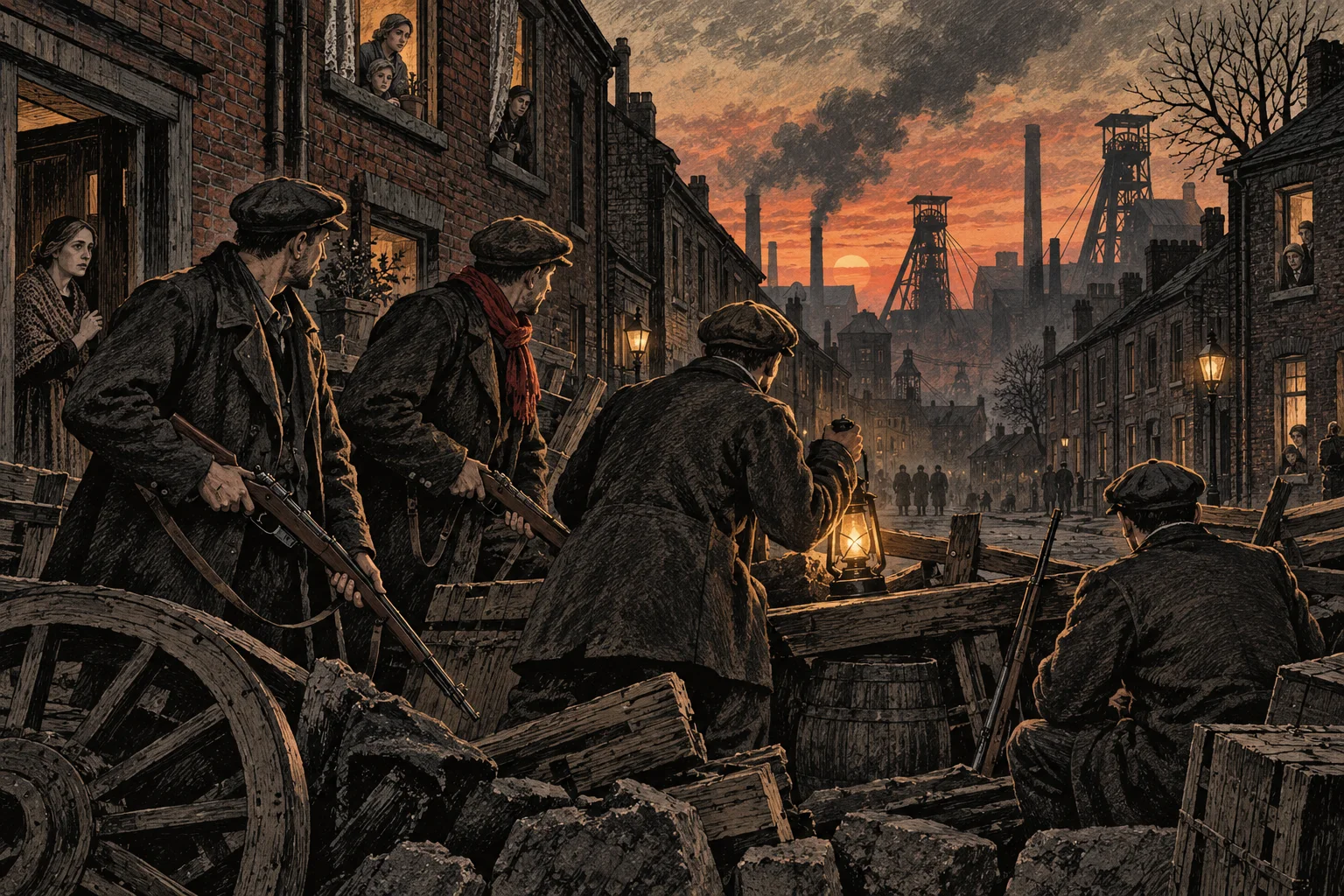
Conflict in the workplace
Germany’s defeat in the First World War opened a dispute over Upper Silesia’s state affiliation. The Polish movement sought incorporation into the restored Polish state; the German camp sought to retain the region in Germany. Neither side represented a uniform community.
Sources for this passage
- I powstanie śląskie (1919 r.) – okoliczności wybuchuFirst: introductory context; Identity: pp. 50–51
- Celebrating the nation: the case of Upper Silesia after the plebiscite in 1921First: introductory context; Identity: pp. 50–51
In 1919 national tensions overlapped with postwar hardship, strikes and disputes over safety in workplaces. Workers demanded, among other things, the removal of people associated with German armed groups.
Sources for this passage
- I powstanie śląskie (1919 r.) – okoliczności wybuchuFirst: paragraphs before Nieudany zryw; Miners: strike discussion
- „Przybyli po wypłatę górnicy”First: paragraphs before Nieudany zryw; Miners: strike discussion
Mysłowice, 15 August
On 15 August 1919 people who had come to the Mysłowice mine over wage payments were shot and killed. The incident became an important focus for mobilisation. It does not explain the uprising by itself: tensions, strikes and underground preparations were already under way.
Sources for this passage
- I powstanie śląskie (1919 r.) – okoliczności wybuchuFirst: 15 August paragraph; Miners: analysis of triggering-event narrative
- „Przybyli po wypłatę górnicy”First: 15 August paragraph; Miners: analysis of triggering-event narrative
Preparations for the uprising
The Polish Military Organisation of Upper Silesia prepared armed action. Polish activists disagreed over its timing and usefulness. Wojciech Korfanty and the authorities in Warsaw feared the response of the great powers and German military superiority. Arrests of underground organisers further disrupted coordination.
Sources for this passage
- I powstanie śląskie (1919 r.) – okoliczności wybuchuParagraphs on Korfanty and Nieudany zryw
The night of 16–17 August
Maksymilian Iksal’s order, issued during the night of 16–17 August, initially reached some structures in the Pszczyna and Rybnik districts. Fighting began on 17 August and spread to other districts the following day. We therefore date the outbreak to the night of 16–17 August 1919.
Sources for this passage
- I powstanie śląskie (1919 r.) – okoliczności wybuchuNieudany zryw: Iksal and first fighting
Where the fighting took place
Alfons Zgrzebniok assumed insurgent command. The insurgents were less well armed and organised than the German forces, including border-security formations. Local successes did not offset their opponent’s superiority. Major areas of fighting included the Katowice, Pszczyna and Rybnik districts.
Sources for this passage
- I powstanie śląskie (1919 r.) – okoliczności wybuchuNieudany zryw: command, military balance and geography
Repression and refugees
After the fighting was suppressed, some insurgents and their families sought refuge on the Polish side of the border. Repression also affected civilians.
Sources for this passage
- II Powstanie ŚląskieSecond: opening paragraph; First: consequences
- I powstanie śląskie (1919 r.) – okoliczności wybuchuSecond: opening paragraph; First: consequences
The fighting ends
The consulted IPN chronology records the last clashes on 26 August 1919. The uprising ended in military failure; the treaty’s plebiscite remained the basis of an international settlement. The next phase of the conflict would unfold under Allied administration.
Sources for this passage
- I powstanie śląskie (1919 r.) – okoliczności wybuchuNieudany zryw: final two paragraphs
Sources
- I powstanie śląskie (1919 r.) – okoliczności wybuchu
Mirosław Węcki · IPN / Przystanek Historia · 2020-08-16
- Celebrating the nation: the case of Upper Silesia after the plebiscite in 1921
Andrzej Michalczyk · UCL Discovery (research repository)
- „Przybyli po wypłatę górnicy”
Sebastian Rosenbaum · IPN / Przystanek Historia · 2021
- II Powstanie Śląskie
Mirosław Węcki · Instytut Pamięci Narodowej · 2025-08-19
If a source is unavailable, search its title and archival reference with the named institution. A missing document is not replaced with a reconstruction.